Overview
Artificial intelligence is becoming part of everyday software, business operations, and digital services. While traditional AI tools can perform specific tasks based on user instructions, AI agents are designed to take a more active role in completing goals.
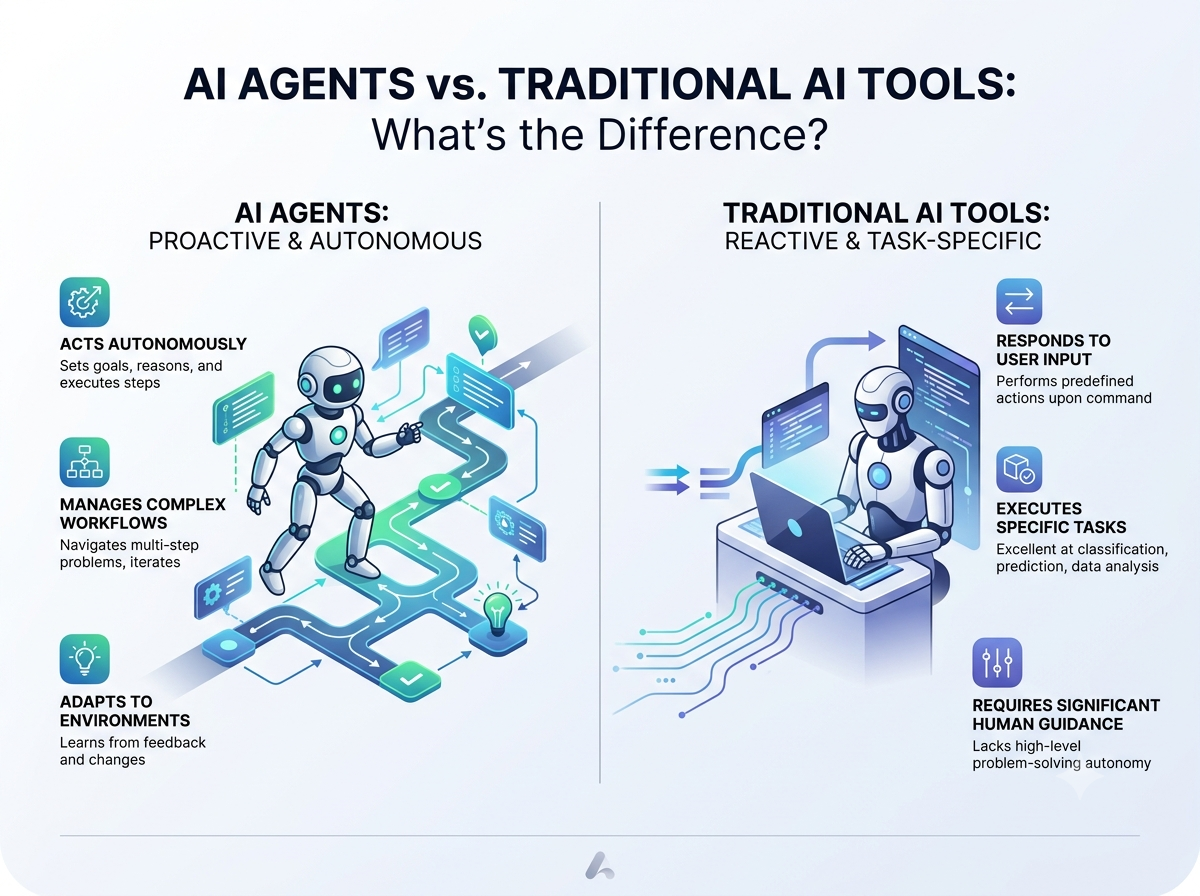
The difference is mainly related to autonomy and how the technology handles tasks. A traditional AI tool may answer a question, generate content, classify information, or make a prediction. An AI agent can potentially plan a sequence of actions, use external tools, evaluate results, and continue working toward a defined objective.
What Are Traditional AI Tools?
Traditional AI tools are generally designed to perform specific functions. They receive an input, process it using an AI model or system, and produce an output.
Examples can include:
- Text generation tools
- Image recognition systems
- Recommendation engines
- Translation tools
- Predictive analytics systems
- Customer-support chatbots
These tools can be highly capable, but they typically operate within a defined task or workflow.
What Are AI Agents?
AI agents are systems designed to pursue a goal by taking multiple steps. Depending on their design, an agent can reason about a task, create a plan, interact with software tools, evaluate results, and adjust its approach.
For example, instead of simply answering a question about a project, an AI agent might gather information, organize it, use connected tools, and produce a completed result.
The exact capabilities of an AI agent depend on its architecture, permissions, tools, and level of human supervision.
Key Differences Between AI Agents and Traditional AI Tools
1. Level of Autonomy
Traditional AI tools generally respond to a specific request.
AI agents can be designed to take multiple actions toward a larger objective with less step-by-step instruction from the user.
2. Task Complexity
Traditional AI is often well suited to individual tasks such as generating text, analyzing an image, or answering a question.
AI agents are designed for multi-step workflows where several actions may be required to reach a final outcome.
3. Tool Usage
Traditional AI tools may operate within their built-in functionality.
AI agents can be connected to external tools such as databases, software applications, APIs, search systems, or business platforms, allowing them to take actions beyond generating a response.
4. Decision-Making
Traditional AI generally produces an output based on its input and the system's design.
An AI agent can be designed to evaluate intermediate results and decide what action to take next based on the current state of a task.
5. Human Involvement
Traditional AI tools often require users to provide instructions for each task.
AI agents can potentially handle a sequence of tasks with less direct intervention, although human approval may still be appropriate for important or sensitive actions.
AI Agents vs. Traditional AI at a Glance
| Feature | Traditional AI Tools | AI Agents |
|---|---|---|
| Main purpose | Specific tasks | Goal-oriented workflows |
| Autonomy | Usually limited | Potentially higher |
| Task structure | Often single-step | Often multi-step |
| Tool usage | May be limited | Can use connected tools |
| Decision-making | Defined response process | Can select next actions |
| Human input | Often frequent | Can be reduced, depending on design |
Where AI Agents Can Be Useful
AI agents can potentially support areas such as customer service, software development, research, business operations, scheduling, data analysis, and workflow automation.
For example, an organization could use an agent to monitor a business process, identify an issue, gather relevant information, and recommend or perform an appropriate action based on predefined permissions.
Challenges of AI Agents
Greater autonomy also introduces additional challenges. Businesses need to consider security, privacy, reliability, monitoring, permissions, and the possibility of incorrect actions.
An AI agent with access to external systems should have carefully defined limits. Human oversight may be especially important when an action could affect finances, sensitive information, customers, or critical business operations.
Will AI Agents Replace Traditional AI Tools?
Not necessarily. Traditional AI tools remain useful for many focused tasks, and not every problem requires an autonomous system.
AI agents are better understood as another layer of AI capability. A business may use a simple AI tool for one task and an agent-based system for a more complex workflow.
Conclusion
The main difference between AI agents and traditional AI tools is their approach to completing tasks. Traditional AI tools generally respond to specific inputs and perform defined functions, while AI agents can be designed to plan, use tools, make decisions, and complete multi-step objectives with greater autonomy.
As AI technology develops, businesses are likely to use both approaches. The most effective choice will depend on the complexity of the task, the level of automation required, and how much control and human oversight the organization needs.