Overview
Hospitals manage large amounts of patient information every day. Medical histories, test results, diagnoses, medications, treatment plans, and other details need to be recorded and made available to authorized healthcare professionals.
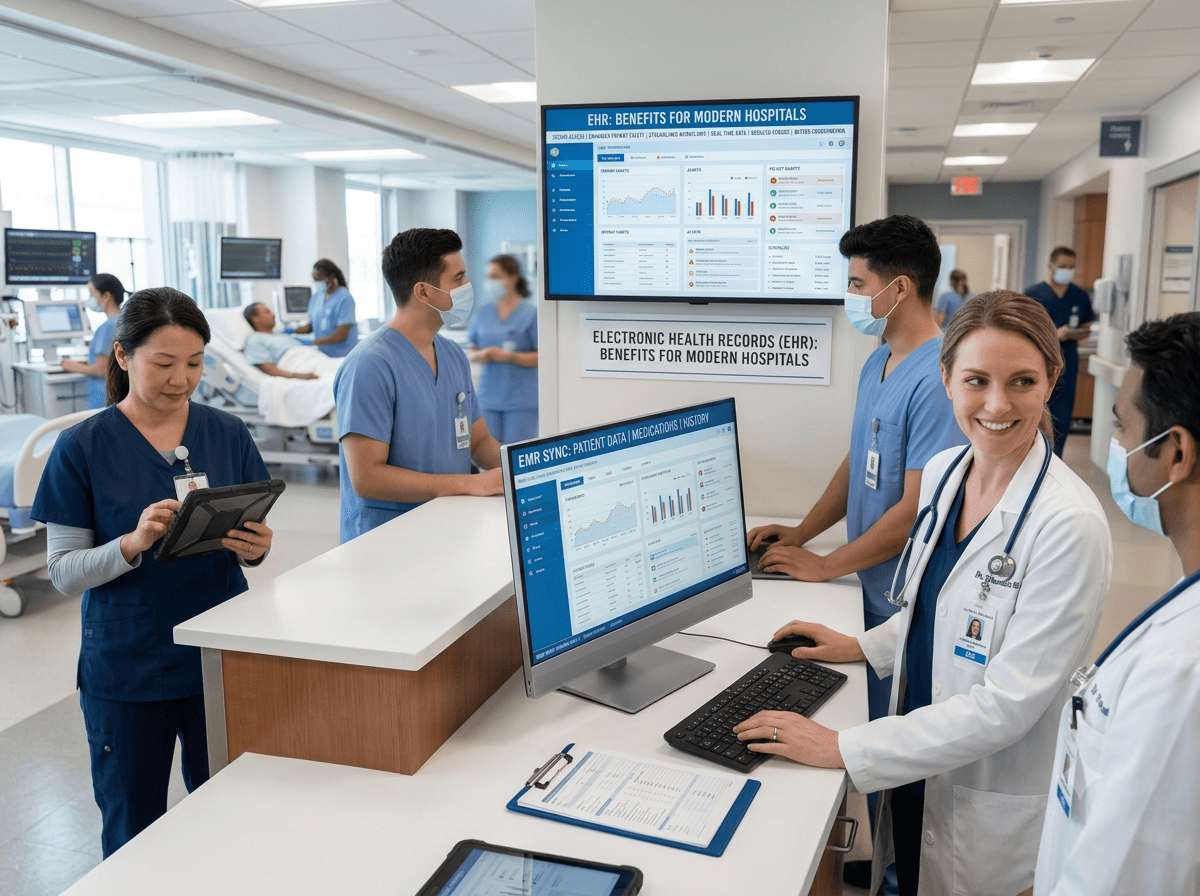
Electronic Health Records, commonly called EHRs, provide a digital way to create, store, organize, and access patient health information. Compared with paper-based records, EHR systems can make information easier to retrieve and share within appropriate healthcare workflows.
What Are Electronic Health Records?
An Electronic Health Record is a digital version of a patient's health information maintained by a healthcare organization or system.
Depending on the system, an EHR can contain information such as:
- Patient medical history
- Diagnoses
- Medication information
- Laboratory results
- Medical imaging information
- Treatment plans
- Clinical notes
- Allergies and other relevant health information
Authorized healthcare professionals can access appropriate information when needed.
Key Benefits of EHR Systems
1. Faster Access to Patient Information
With digital records, authorized staff can retrieve patient information without searching through physical files.
Having relevant information available electronically can help healthcare teams access records more efficiently during patient care.
2. Better Coordination Between Healthcare Teams
Patients may interact with doctors, nurses, specialists, laboratories, pharmacists, and other healthcare professionals.
An appropriately designed EHR system can help authorized members of the care team access shared information, improving coordination and reducing the need to repeatedly collect the same information.
3. Reduced Paperwork
Paper-based record keeping can require significant storage space and administrative effort.
EHR systems reduce dependence on physical documents and can automate or simplify certain documentation and record-management processes.
4. Improved Record Organization
Digital systems can organize different types of patient information in a structured format.
Healthcare professionals can search for specific information rather than manually reviewing large collections of paper records.
5. Support for Clinical Decisions
EHR systems can provide healthcare professionals with access to relevant patient information during care.
Some systems can also provide alerts or reminders based on configured rules. These features can support clinical workflows, although healthcare professionals must still use their judgment.
6. Easier Information Sharing
In appropriate circumstances, electronic systems can make it easier to share relevant patient information between authorized healthcare providers.
Interoperability between different healthcare systems is important because patients may receive care from multiple organizations.
7. Improved Administrative Efficiency
EHR systems can support scheduling, documentation, billing-related workflows, reporting, and other administrative processes.
Automating suitable tasks can reduce repetitive work and allow hospital staff to focus more attention on patient care and other important responsibilities.
Challenges of EHR Implementation
Although EHRs offer many benefits, implementing them can be complex.
Data Security
Patient health information is sensitive. Hospitals need strong security measures, access controls, monitoring, and appropriate policies to protect digital records.
Staff Training
Healthcare professionals need training to use EHR systems effectively. Poorly designed workflows or insufficient training can make systems difficult to use.
Implementation Costs
Setting up an EHR system can require investment in software, hardware, infrastructure, training, maintenance, and support.
Interoperability
Different healthcare systems may use different technologies and data formats. Ensuring that systems can exchange information accurately and securely remains an important challenge.
The Future of EHR Technology
EHR systems are continuing to evolve. Modern healthcare organizations are increasingly exploring better interoperability, cloud-based infrastructure, data analytics, automation, and AI-supported capabilities.
Future EHR systems may provide healthcare professionals with more efficient ways to access and understand patient information while reducing unnecessary administrative work.
Conclusion
Electronic Health Records have become an important part of modern hospital technology. They can improve access to patient information, support collaboration between healthcare teams, reduce paperwork, and streamline administrative and clinical workflows.
However, the success of an EHR system depends on more than simply moving records from paper to digital. Security, usability, interoperability, staff training, and responsible data management are essential for ensuring that EHR technology genuinely supports healthcare professionals and patients.