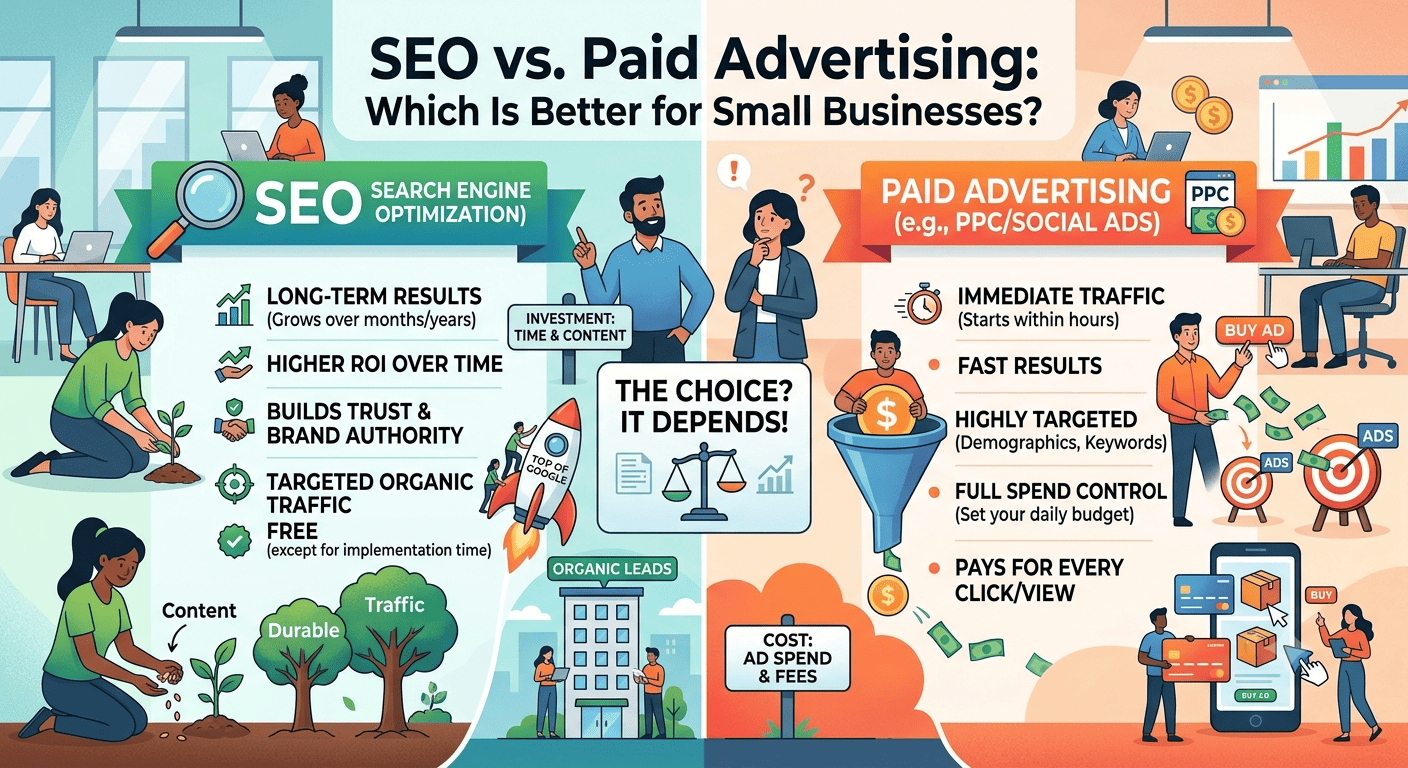
Overview
For small businesses, attracting customers online can be challenging, especially when competing with larger companies. Search Engine Optimization (SEO) and paid advertising are two popular digital marketing strategies that can help businesses increase their online visibility.
SEO focuses on improving a website's ability to appear in organic search results, while paid advertising allows businesses to pay for promotional placements on search engines, social platforms, websites, and other digital channels.
Neither approach is automatically better for every business. The right choice depends on the company's budget, goals, competition, target audience, and how quickly it needs results.
What Is SEO?
SEO involves improving a website and its content so that search engines can better understand and rank its pages for relevant searches.
SEO can include activities such as:
- Creating useful and relevant content
- Improving website structure
- Optimizing page titles and descriptions
- Improving website speed and user experience
- Building relevant and trustworthy links
- Targeting appropriate search queries
The goal is to build organic visibility that can continue generating traffic over time.
What Is Paid Advertising?
Paid advertising involves paying platforms to display advertisements to a selected audience. Businesses can target users based on factors such as search queries, interests, location, demographics, or online behavior, depending on the advertising platform.
Paid campaigns can provide businesses with greater control over budgets, targeting, messaging, and campaign timing.
Key Differences Between SEO and Paid Advertising
1. Speed of Results
Paid advertising can start generating visibility and traffic soon after a campaign is launched.
SEO usually takes longer because websites need time to build authority, improve rankings, and generate consistent organic visibility.
2. Cost Structure
SEO generally requires investment in content, technical improvements, expertise, and ongoing optimization. Businesses do not usually pay search engines directly for each organic click.
Paid advertising requires a direct advertising budget, with costs depending on the platform, competition, targeting, and campaign performance.
3. Long-Term Value
A successful SEO strategy can continue attracting organic traffic after individual pieces of content have been published.
Paid advertising generally stops generating paid traffic when the campaign budget is paused or exhausted.
4. Targeting
Paid advertising often provides detailed targeting options, allowing businesses to select specific audiences and campaign objectives.
SEO targeting is primarily based on the search terms and topics for which a website can build relevant organic visibility.
5. Competition
SEO can be highly competitive, particularly for popular search terms. Businesses may need consistent content and optimization efforts to compete.
Paid advertising can also be competitive because advertisers may compete for valuable keywords and audiences.
SEO vs. Paid Advertising at a Glance
| Feature | SEO | Paid Advertising |
|---|---|---|
| Results | Usually slower | Usually faster |
| Payment model | Investment in optimization | Direct advertising spend |
| Long-term potential | High | Depends on ongoing budget |
| Targeting | Primarily search intent | Detailed audience options |
| Best for | Sustainable organic visibility | Immediate campaigns and traffic |
Which Is Better for Small Businesses?
The answer depends on the business.
SEO can be valuable for a small business that wants to build long-term visibility and attract customers through relevant searches. It can be particularly useful for businesses that can consistently create helpful content and improve their website.
Paid advertising may be more suitable when a business needs immediate visibility, is promoting a specific offer, or wants to test a market quickly.
Can Small Businesses Use Both?
Yes. SEO and paid advertising can complement each other.
For example, a business can use paid advertising to generate immediate traffic while gradually developing its SEO strategy. Data from paid campaigns may also provide insights into customer interests and search behavior that can inform future content.
Using both approaches can create a balance between short-term visibility and long-term organic growth.
Conclusion
SEO and paid advertising serve different purposes. SEO focuses on building organic visibility over time, while paid advertising can provide faster exposure through targeted campaigns.
For many small businesses, the strongest approach may not be choosing one over the other. A balanced strategy can use paid advertising for immediate opportunities while investing in SEO to build sustainable online visibility for the future.
