Overview
A website is an important digital asset for many modern businesses. It can help companies present their services, attract customers, generate leads, sell products, and build an online presence. However, businesses have different options when creating a website.
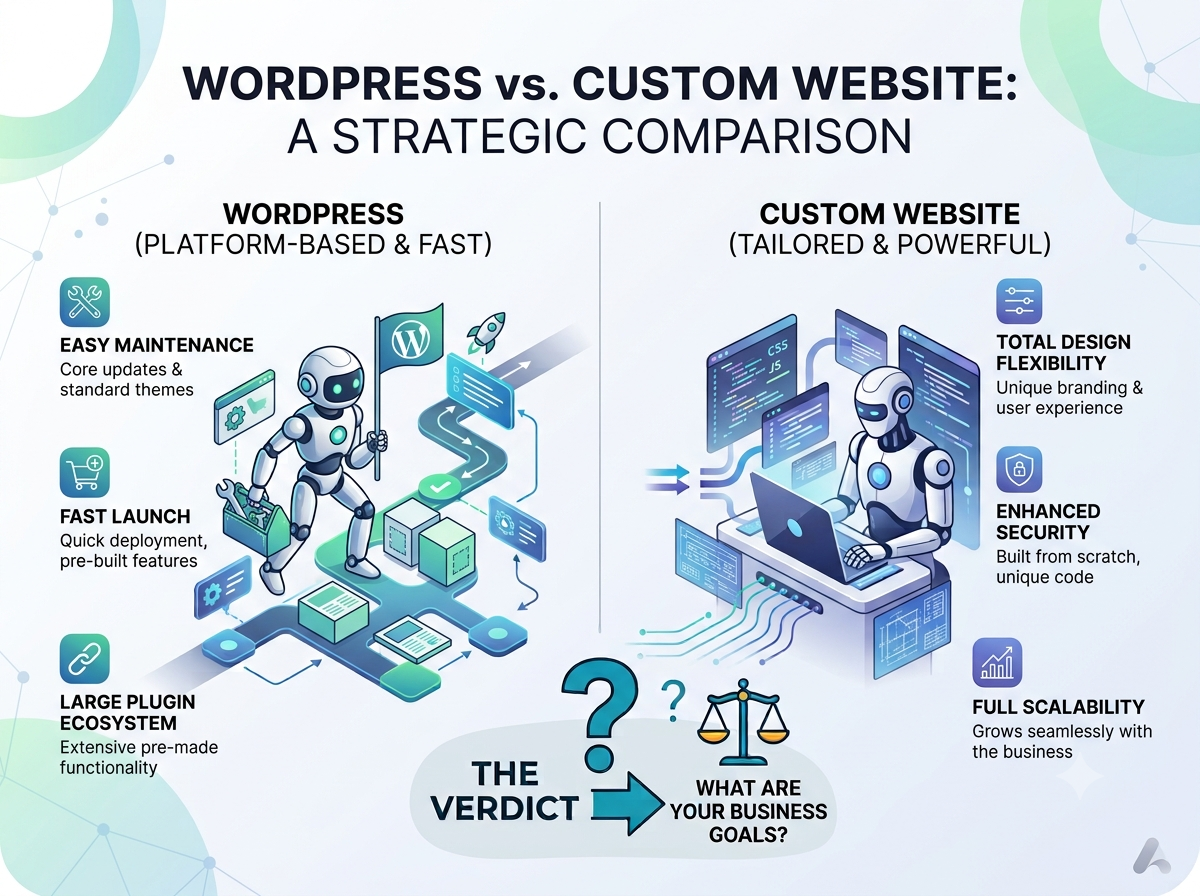
WordPress provides a ready-made content management system that businesses can customize using themes, plugins, and other tools. A custom website is developed specifically for a business, giving developers greater control over its design, features, and underlying technology.
The better option depends on the company's goals, budget, timeline, and technical requirements.
What Is a WordPress Website?
WordPress is a content management system that allows users to create and manage websites without building every component from scratch.
Businesses can choose from different themes and extend functionality through plugins and custom development. This makes WordPress suitable for many websites, including business websites, blogs, portfolios, news sites, and online stores.
What Is a Custom Website?
A custom website is designed and developed specifically around a company's requirements. Developers can create the user interface, functionality, database structure, and integrations according to the project's needs.
This approach provides greater control but generally requires more development time, technical expertise, and investment.
Key Differences Between WordPress and Custom Websites
1. Development Cost
WordPress can be relatively affordable because businesses can use existing themes, plugins, and hosting solutions.
Custom websites generally require more development work, which can increase the initial cost. However, the final cost depends heavily on the complexity of the project.
2. Development Time
A basic WordPress website can often be launched relatively quickly using an existing theme and configuration.
Custom development usually takes longer because the website's features and design are built specifically for the business.
3. Customization
WordPress provides extensive customization options through themes, plugins, and development. However, businesses may sometimes need to work within the structure of the platform or selected tools.
A custom website provides greater freedom to create unique functionality and user experiences.
4. Maintenance
WordPress websites require ongoing maintenance, including updates for the core platform, themes, and plugins. Security and compatibility should also be monitored.
Custom websites also require maintenance, but the exact requirements depend on the technology stack and architecture used to build the site.
5. Scalability
WordPress can support many types of growing websites when it is properly configured and maintained.
A custom website can be designed around specific scalability requirements from the beginning. This can be useful for businesses that expect complex workflows, high traffic, or specialized functionality.
6. Technical Expertise
WordPress can be easier for non-technical users to manage, particularly for common content updates.
Custom websites typically require developers or technical teams for significant changes, depending on how the system has been built.
WordPress vs. Custom Website at a Glance
| Feature | WordPress | Custom Website |
|---|---|---|
| Initial cost | Often lower | Usually higher |
| Launch time | Often faster | Usually longer |
| Customization | High | Very high |
| Technical control | Moderate to high | Very high |
| Maintenance | Regular platform/plugin updates | Depends on technology |
| Best for | Many standard business needs | Specialized requirements |
When Should a Business Choose WordPress?
WordPress can be a good choice when a business needs a professional website within a reasonable budget and timeframe.
It can work well for company websites, blogs, service businesses, portfolios, content-driven websites, and many small or medium-sized business projects.
When Should a Business Choose a Custom Website?
Custom development may make more sense when a business requires specialized features that are difficult to achieve efficiently with standard WordPress tools.
It can be suitable for businesses that need unique workflows, complex integrations, specialized user experiences, or highly specific technical requirements.
Which Is Better?
There is no universal winner. Choosing WordPress simply because it is cheaper or choosing custom development simply because it is more flexible can both lead to the wrong decision.
Businesses should first identify their goals, required features, budget, expected traffic, maintenance capabilities, and long-term plans. The technology should then be selected based on those requirements.
Conclusion
WordPress and custom websites can both be effective business solutions. WordPress offers convenience, flexibility, a large ecosystem, and potentially lower development costs. Custom websites provide greater control and can be designed specifically around complex business requirements.
For many businesses, WordPress may be the practical starting point. For companies with highly specialized needs, custom development may provide greater long-term flexibility. The best choice is the one that supports the business's actual goals rather than simply following a technology trend.