Overview
Modern software applications rarely work completely on their own. Applications often need to communicate with other systems to retrieve information, process payments, send messages, access maps, authenticate users, or use external services. APIs make these interactions possible.
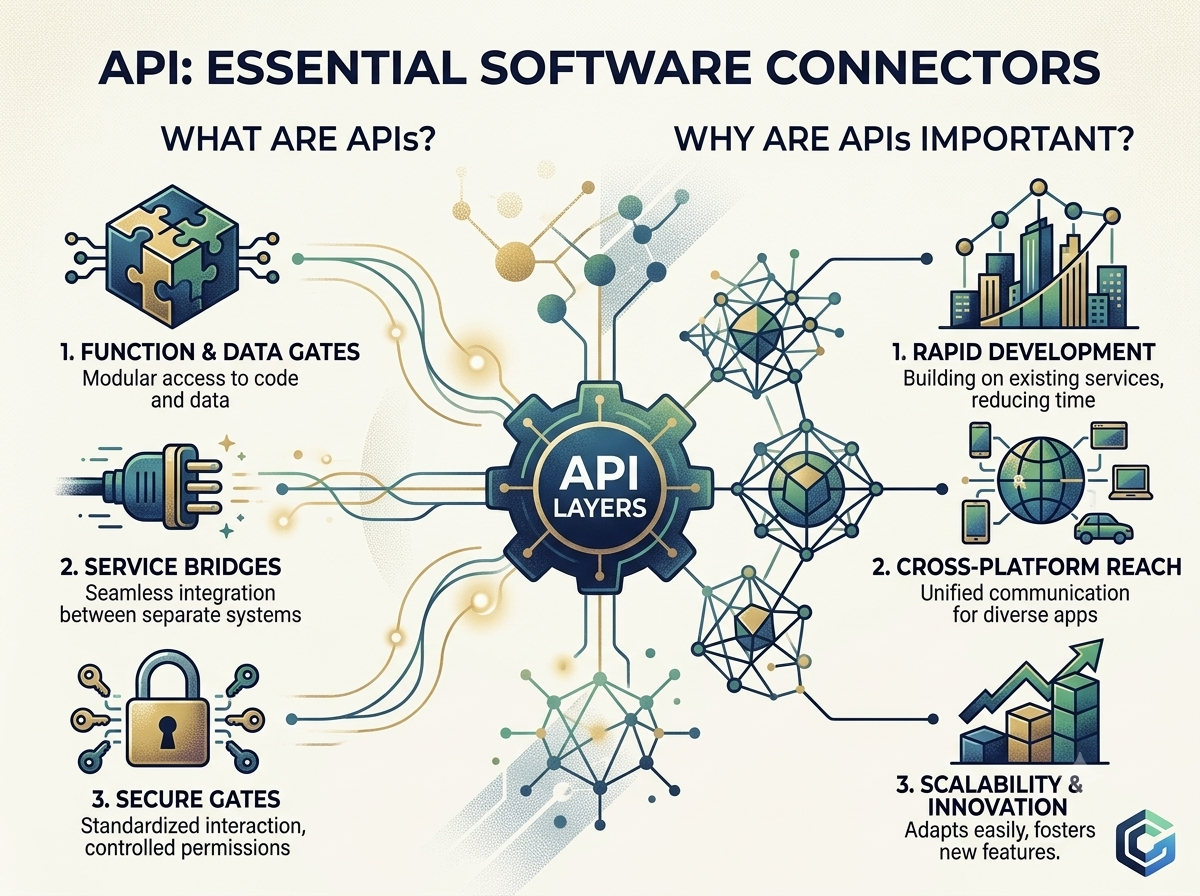
API stands for Application Programming Interface. An API provides a defined way for one software system to request data or functionality from another system without needing to understand how that system works internally.
How APIs Work
An API acts as an interface between different software components.
For example, when a mobile application needs information from a server, it can send a request through an API. The server processes the request and sends an appropriate response back to the application.
The API defines how requests should be made, what information can be requested, and what type of response the application should expect.
Why APIs Are Important
1. Connect Different Systems
APIs allow different applications and services to communicate with each other. A single application can connect to multiple systems without building every function from scratch.
For example, an application may use separate APIs for payments, maps, authentication, messaging, or analytics.
2. Speed Up Software Development
Developers can use existing services through APIs instead of creating every capability themselves.
This can reduce development time and allow teams to focus on the unique features of their own applications.
3. Enable Third-Party Integrations
APIs allow businesses to connect their products with external platforms and services.
For example, an online store might connect its system with a payment provider, shipping service, customer-management platform, and accounting software through APIs.
4. Support Mobile and Web Applications
Modern mobile and web applications commonly communicate with backend systems through APIs. The application can request information from a server and display the returned data to users.
This separation can make it easier for organizations to support multiple types of applications using shared backend services.
5. Improve Automation
APIs can allow software systems to exchange information automatically. Businesses can use API-based integrations to automate tasks that would otherwise require manual data entry or repetitive processes.
This can improve efficiency and reduce the possibility of human error.
6. Support Scalable Software Architecture
APIs can help organizations separate different parts of a software system. Services can communicate through defined interfaces rather than depending directly on each other's internal implementation.
This approach can make large systems easier to develop, maintain, and update when designed properly.
Common Types of APIs
REST APIs
REST APIs are widely used for communication between web services. They commonly use HTTP methods such as GET, POST, PUT, and DELETE to work with resources.
GraphQL APIs
GraphQL allows clients to request specific data through a structured query system. This can be useful when applications need flexible control over the information they receive.
Web APIs
Web APIs allow applications to communicate over the internet. They are commonly used by websites, mobile applications, cloud services, and other online systems.
API Security
Because APIs can provide access to data and functionality, security is an important consideration. Developers may use authentication, authorization, encryption, rate limits, input validation, and monitoring to help protect APIs.
Poorly secured APIs can expose sensitive information or allow unauthorized actions, making proper API design and security essential.
Real-World Example
Consider a food delivery application. The application may use APIs to connect several services:
- A mapping service for location and directions
- A payment service for transactions
- A restaurant system for menu information
- A notification service for order updates
- A customer account system for authentication
The user sees one application, but APIs can allow multiple systems to work together behind the scenes.
Conclusion
APIs are one of the foundations of modern software development. They allow applications, platforms, and services to communicate without requiring every system to understand the internal implementation of another.
By enabling integration, automation, faster development, and scalable architectures, APIs help businesses build connected digital experiences. As software becomes increasingly interconnected, APIs will continue to play an important role in how modern applications are designed and delivered.